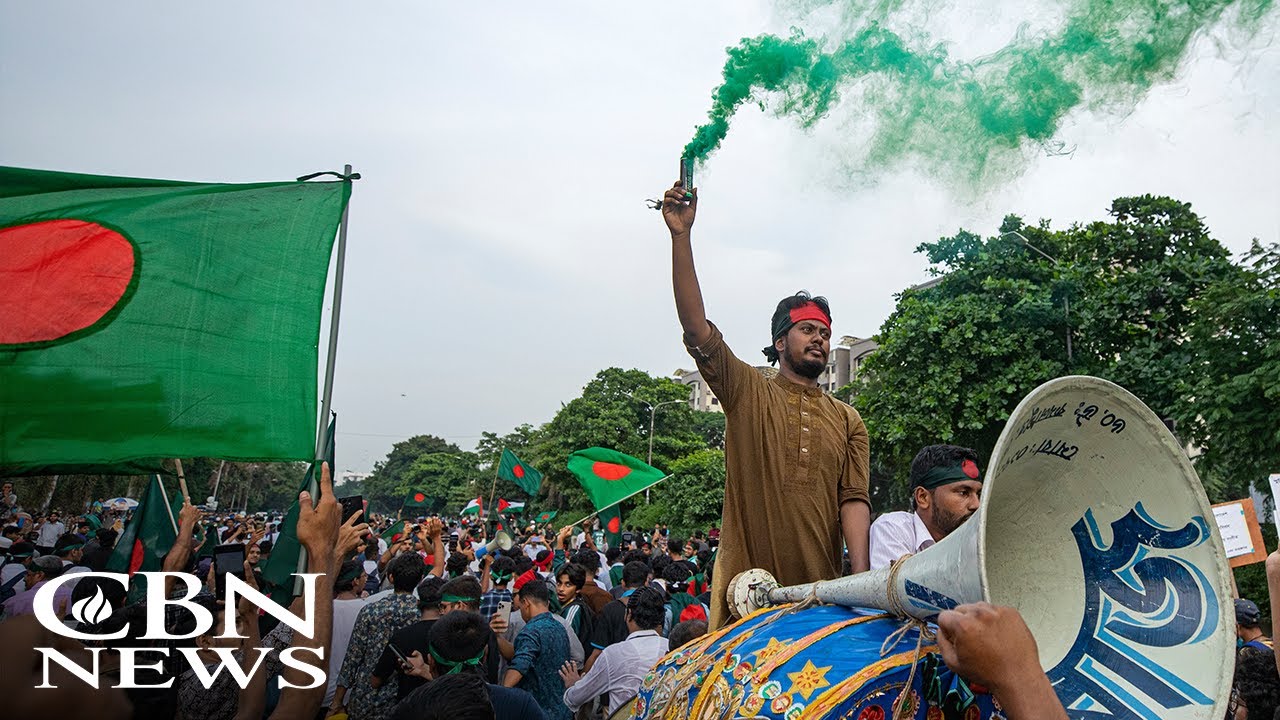
Weeks of protests in Bangladesh led to the government’s resignation. csi
Four weeks after sustained popular protests forced Sheikh Hasina to quit and flee the country, the situation for religious minorities such as Christians and Hindus is worsening. The 84-year-old interim president, Nobel Prize winner Muhammad Yunus, appears powerless to prevent the increasing Islamization.
Hasina’s Awami League administration had banned the Islamist opposition party Jamaat-e-Islami from taking part in elections. Founded in 1941, the party supported the Pakistani military during Bangladesh’s war of independence in 1971. During Hasina’s time in office, most of its leaders were jailed or executed over their role in the war.
Resurgent Islamist forces
On August 1, 2024, at the height of the student protests that toppled the government, Hasina accused Jamaat-e-Islami of terrorism and banned it outright. The interim government has now lifted this ban on the major Islamist party and its student wing, giving it free reign to operate in the country.
Another previously banned Islamist organization, Hizb ut-Tahrir, is also said to be steadily gaining in influence. A global Islamic fundamentalist movement that is banned in many countries, Hizb ut-Tahrir is apparently building a strong support base and is wielding influence over the interim government.
At a rally held in early August, Hizb ut-Tahrir made its anti-minority stance clear. According to CSI’s local project partner, it issued a call for Bangladesh to become a 100-percent Islamic country. Meanwhile, Hizb ut-Tahrir mobs have taken to the streets to threaten Christians and Hindus with violence.
“They demonstrated in front of our office and house. They were carrying swords and firearms,” said CSI’s partner. “For five nights running they threatened all the Christians in the area. They marked the gates with the cross.”
Teachers forced to resign
Over the past four weeks, a process of Islamization has occurred in all administrative areas, not least in the country’s educational establishments, according to CSI’s partner.
“In public and private universities, colleges, high schools and elementary schools principals and teachers from minority communities have been forced to resign and their positions given to the followers of Jamaat-e-Islami,” our partner said. He added, “Now that the process is underway, it is assumed that no members of religious minorities will again be hired as teachers in any educational institution.”
The Roman Catholic archbishop of Dhaka, Bejoy D’Cruze, on August 24 issued a statement announcing the closure of all Catholic-run schools in Dhaka owing to the ongoing instability.
In an interview with Vatican News a few days later, D’Cruze explained that in addition to calling for the resignation of teachers, student protesters were complaining about the uniform worn in Catholic schools. “They were demanding the veil, the hijab, which is the Islamic dress, be imposed in our schools for the girls,” the archbishop said.
Purge in law-enforcement
Sweeping changes are also apparent in the judiciary. Judges and prosecutors considered loyal to Hasina have been forced out of office and their places taken by fundamentalist Muslim lawyers. Purges have also taken place in the ranks of the police.
“Many of the Christians who were given jobs in the judicial sector and in various law enforcement agencies, including the police, under the previous government have been sacked and transferred to remote areas,” said CSI’s local partner.
He sees the appointment of radical Muslims to sensitive positions in the judiciary as an ominous sign that “minorities and secular Bangladeshis will no longer receive justice.”
There is already evidence that this is occurring, our partner said.
“Minority leaders have been accused in various cases and their religion has been used before the mention of their name, such as adding Christian before the name Vipul and referring to Christian Vipul. This is understood as a reflection of religious hatred.”
CSI’s partner, who has now left the country for his own safety, speaks of a “civil war atmosphere” in Bangladesh where looting is taking place during house-to-house searches conducted in the name of students and other forces. He requests prayers for peace and stability.